
On-Page SEO: How to Optimize Your Pages to Rank Higher
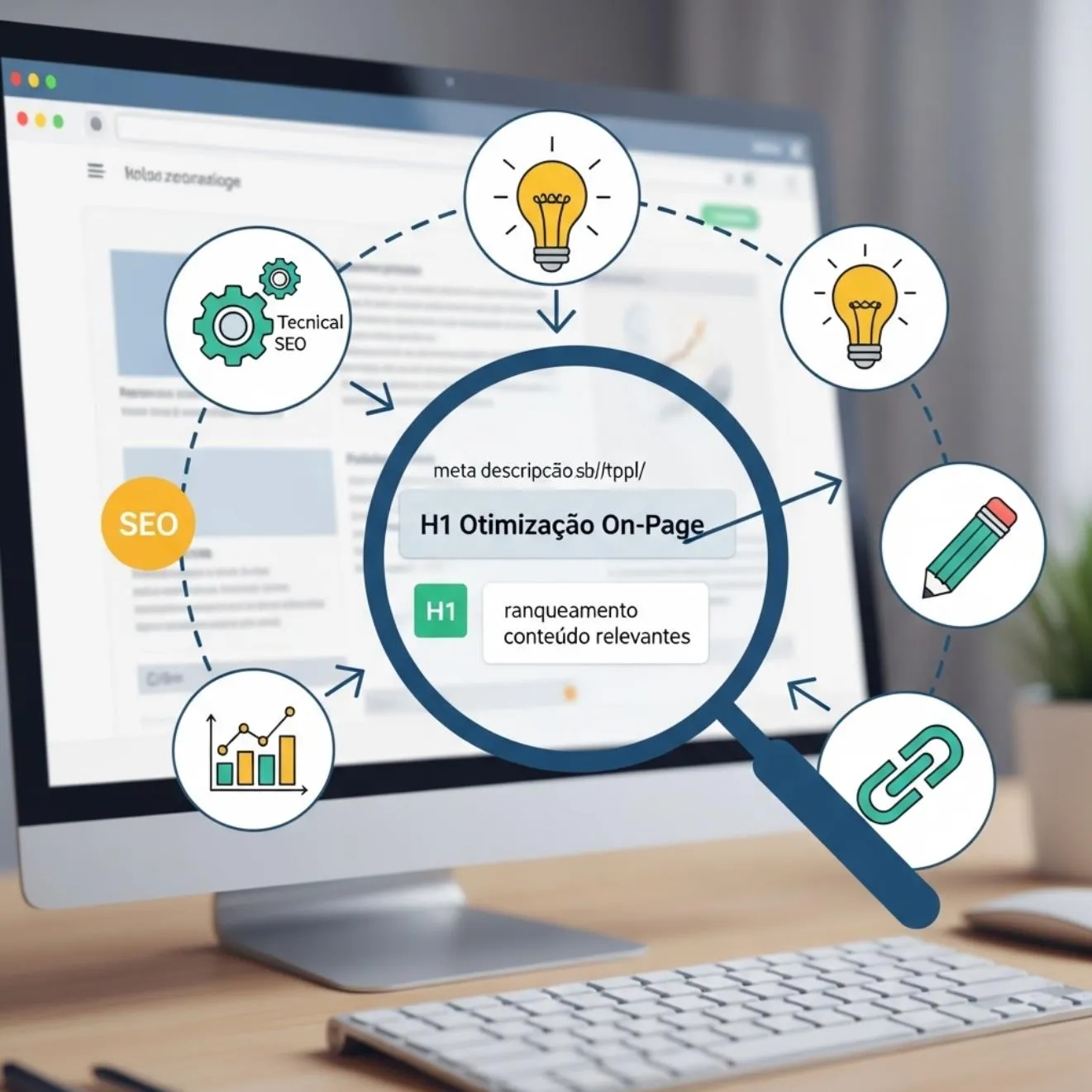
You’ve already laid your house’s foundation with good technical SEO. Now it’s time to decorate, organize and label every room so visitors, both Google and your customers, know exactly where to find what they’re looking for. That’s exactly what on-page SEO does. While technical SEO takes care of your site’s infrastructure (the “invisible” part), on-page SEO focuses on every element within your page.
It’s the art of optimizing your content and structure to clearly signal to Google what your page is about, how relevant it is and why it deserves the top spot. Mastering it is a pillar of any successful SEO strategy.
What Is On-Page SEO? Signposting Your Content
On-page SEO is the set of optimizations you apply directly to a specific page on your site to improve its position in search engines. That includes optimizing titles, the content itself, images, internal links and other elements.
A simple analogy: imagine your page is a book. On-page SEO means making sure the book has a clear title (title tag), a well-organized table of contents (H2 and H3 headings), chapters that make sense (quality content) and illustrations with captions (optimized images). Without that organization, it would just be a jumble of words, hard to read and understand.
The 7 Crucial On-Page SEO Factors Your Business Needs to Master
To keep things practical, let’s focus on the seven elements with the biggest impact on your rankings. Fine-tuning them is the fastest way to see results.
1. Title Tag (Your Storefront Title on Google)
The title tag (or SEO title) is the clickable blue headline that appears in Google’s search results. It’s the user’s first contact with your page and perhaps the single most important on-page SEO factor.
What it is: the main title that summarizes your page’s content for Google and users.
How to optimize it:
-
Put the keyword at the start: for example, “On-Page SEO: The Complete Guide”.
-
Keep it under 60 characters: so it isn’t cut off in results.
-
Make it appealing: use numbers, questions or adjectives that encourage clicks.
2. Meta Description (The Invitation to Click)
It’s the short descriptive text that appears just below the title tag on Google. Although it isn’t a direct ranking factor, it has huge power over your click-through rate (CTR).
What it is: a summary of up to about 150 characters of what users will find on the page.
How to optimize it:
-
Include the keyword: Google may bold it if it matches the user’s search.
-
Use a call to action (CTA): “Learn how”, “Discover the secrets”, “See our guide”.
-
Answer the question: make it clear that the answer the user is looking for is right there.
3. Relevant, High-Quality Content
This is the heart of your page. There’s no point optimizing everything else if your content is weak. Google wants to show the best result, and that means content that fully and clearly answers the user’s search intent.
What it is: text, video or material that solves the searcher’s problem or question.
How to optimize it:
-
Originality: never copy content from other sites.
-
Depth: cover the topic completely. Use data and intelligence to understand what questions your audience asks about the subject.
-
Readability: use short sentences, small paragraphs and bold for key terms.
4. Headings (H1, H2, H3): Your Text’s Structure
Headings (titles and subtitles) organize your content into a logical hierarchy, making it easier for users to read and for Google’s bots to understand.
What they are: tags that define your text’s structure.
How to optimize them:
-
Use only one H1 per page: it should be your content’s main title (usually the same as or very close to the title tag).
-
Use H2s and H3s to organize: create logical sections and subsections.
-
Include keywords and variations: use subheadings to cover subtopics related to your main keyword.
5. Image Optimization
Images make your content more appealing, but they need SEO too. Google doesn’t “see” images; it “reads” the information associated with them.
What it is: optimizing image files and their attributes for SEO.
How to optimize them:
-
Alt text: describe the image concisely. For example:
alt="on-page SEO optimization checklist". This helps accessibility and rankings in Google Images. -
File name: give the file a descriptive name before uploading. For example,
on-page-seo.jpginstead ofIMG_12345.jpg. -
Compression: use free SEO tools (like TinyPNG) to reduce file size without losing quality, helping site speed (a technical and on-page SEO factor).
6. SEO-Friendly URLs
The URL is your page’s address on the web. A clean, descriptive URL is better for users and for SEO.
What it is: your page’s web address.
How to optimize it:
-
Short and descriptive: keep the URL as short as possible.
-
Include the keyword: for example,
yoursite.com/blog/on-page-seo -
Use hyphens to separate words: avoid underscores (
_) or spaces.
7. Internal Links
These are links from one page on your site to another page on your own site. They’re extremely important for navigation and SEO.
What they are: links that connect your own content.
How to optimize them:
-
Be relevant: link to other articles or pages that complement the information.
-
Use descriptive anchor text: instead of “click here”, use “read our technical SEO guide”. This gives Google context about the destination page.
On-Page, Technical and Off-Page SEO: The Trio of Success
It’s essential to understand that these strategies don’t work in isolation.
-
Technical SEO makes sure your page is accessible and fast.
-
On-page SEO makes sure it’s clear and relevant.
-
Off-page SEO (links from other sites) builds its authority and reputation on the web.
Real strategic SEO harmonizes these three pillars. That’s the only way to build digital technology that delivers consistent results, whether for a small business or enterprise solutions.
Turn Every Page into a Salesperson with Malamute Digital
Optimizing every detail of every page on your site can feel like never-ending work. And in fact, it’s an ongoing process of improvement.
At Malamute Digital, we live and breathe this. Our team of SEO specialists handles your entire on-page strategy: from keyword research to meticulous content optimization.
We use data and intelligence to make sure every page on your site isn’t just found but also delights and converts your visitors.
So if you want to make sure your site is perfectly optimized for Google, talk to a Malamute specialist and find out how our SEO solutions can boost your business.
Also available in: Português · Italiano · Español
Want to turn organic search into revenue?